Pages

Friday, March 20, 2015

Playing and Being at Laurie's House


We begin our day greeting the children as they arrive, visiting with parents and then saying good-bye to them. The morning transition is often the hardest part of the day; I comfort upset children and reassure them that the people they love will come back, and I comfort upset parents and assure them that their child will be okay. Then we do whatever the children need: eat, sleep, diapering and play. As they get older a routine emerges, with a morning snack, lunch, mid-day nap and afternoon snack as the touchstones of the day. We try to get outside every day. Because relationships are such a core part of early care and education I maintain a primary caregiving relationship with the children…
… My goal is to provide the optimally stimulating and nurturing environment that a young child would encounter in a healthy home – ordinary reality, life in its goodness.  We spend our days together in my small home, learning in the way that young children do: for example, playing with pots and pans, being read to, resolving conflicts and exploring.

From my website: Laurieshouse.com 


When I decided that I wanted to do infant care in my home 22 years ago, I looked at what my community needed and what I could offer.  

It was clear that there was a shortage of good infant care, and that most infant programs in the area required full time enrollment in order to make their budget. I wanted to support parents spending more time with their babies by working part time if they had that option. This worked better for me as well, because as I completed my MA in Human Development I knew I wanted to spend some time teaching adults as well as working with babies – I needed that balance in my life.  So I am open 4 days a week, and parents can sign up for between 20 and 36 hours of care per week.

Having studied with Magda Gerber, who developed the RIE method of infant care, I valued the concept of respectful care that allows for children to develop as authentic and competent people. From Liz Prescott at Pacific Oaks College, I embraced the idea that family child care could be as good as center care, and provided an ideal setting for children to experience the ways in which  we meet day-to-day human needs – an essential part of the early years curriculum in my view. I liked the idea of providing care in a small, home-based, non-institutional environment.  From Betty Jones, also at P.O., I learned about the value of providing a safe space with an abundance of interesting things to do, and letting children explore freely within it. 


Because I wanted to develop deep relationships with families, and provide continuity of care I decided that every three years I would enroll a new group of four infants, between about 3 and 9 months old, and that they would stay together as a cohort until leaving for pre-school. I enjoy creating a small, stable community for children in their first years, and children benefit from having a primary caregiver in a small group during that time. When I enroll families we talk about the intention we share to stay together for three years; twice families have had to leave before the end of that period and I have filled their slot with another child of roughly the same age.

In Oregon, as a Certified Family Child Care Provider, I am able to care for up to 4 infants at a time. We arrange the schedule so that when they are tiny they’re not all here at once, or if they are I have some help. So our ratio is always 1 to 4 or better. I often have help from my part time assistant Katie, from my partner Terri, and from practicum students. The children in each cohort develop deep connections with each other, and we spend lots of time developing language and problem-solving skills together.

Sometimes I want to say that what we do here is nothing special, or that we’re hanging out with babies the way people always have, but I know it’s much more than that. In a speeded up world we provide a place for babies and their parents to slow down and enjoy the richness of the early years. Daily life and caregiving is our curriculum; we try to take the time to honor young children’s interest in the mundane aspects of life that adults often ignore.

Some examples are:

Our toddler field trips are the hour long walks around the block where children become intimately familiar with the geography of this place, and the beings that inhabit it. We know which neighbors have given permission for us to run up and down their steep driveway, and which lawns we need to stay off of, we know that Pearl the neighbor cat can often be found a block away taunting the squirrels, we know which plants are okay to touch and which ones we should avoid – we end up knowing a lot about ourselves and this place. That knowledge provides a solid base for moving out into the wider and more diverse world.

I’ve joked that I don’t need to hire magicians and clowns to entertain the children because in this old house we have regular visits from workers who help us maintain it. There’s Tom, our painter who comes every spring, and makes smiley faces on the windows with blue painters tape, there’s the plumber who glows as I explain to the children that good plumbing is one of the foundations of civilization and public health, and Julie who comes a couple of times a year to prune our trees and shrubs. She leaves us piles of sticks to sort through, and we learn that if we leave them for a while they become dry enough for us to break! 


Of course food is an essential part of the infant/toddler curriculum, and in this small setting with a little garden and access to the kitchen, children are able to explore it fully with all their senses. One of my favorite materials to put out for babies is an unpeeled onion - the textures, the smells, the taste, the conversations about cooking with onions – I can’t think of any toy that offers such rich possibilities!


In part because I began with a minimal budget, and in part because I value reuse and non-commercial materials, I mix in lots of boxes, scrap paper, empty bottles, avocado pits and other found treasures for the children to explore (Tom Hunter’s line “we just call it garbage when we don’t know what to do with it” is a great inspiration for this kind of reuse). These materials mix easily with the open ended purchased objects in the environment, and are used just as much if not more.

In being together here in very ordinary ways, we learn that life is delightful and play is what it’s all about!

Wednesday, March 18, 2015

The Magic in "YES" - Part 1


Are you ready to join me on a journey?  This journey is always evolving, always magical and always a learning experience.  This journey is a "yes" journey. 

Let me take you back a few years… I was a preschool teacher that saw control as the only way to run an early childhood program.  I went to class already feeling stressed and left even more stressed.  There was so much to manage.  I had to manage the way the children moved from center to center.  I managed the way they stood in line and the way they sat at circle time.  I managed the way that children created their “art” projects and the way they went down the slide.    I managed the way children spent their “free choice” time – it wasn’t really free and there wasn’t a lot of choice.  Children were showing me that they needed freedom to make choices but I understood it as misbehavior.

Why was I teaching this way?  I was teaching from the example of others.  I was taking my experience teaching in the early elementary grade levels and trying to bring those experiences down to the preschool level.  I was under the impression that children needed constant, teacher directed reinforcement of letters and numbers, rhyming and patterning and counting so I could “get them ready for Kindergarten” (those are my five most despised words now  -  that is a can of worms for another blog post).

My life was about to change in a BIG way.

I went to a conference where Lisa “Ooey Gooey” Murphy was the keynote speaker.  IT WAS LIFE CHANGING.  I was only in my second year of teaching preschool at the time.  I look back and thank God that I was fortunate enough to listen to her speak about PLAY that early in my preschool teaching career.  I often wonder where I would be had I not heard Lisa speak.  Soon after I was introduced to Jeff Johnson and Denita Dinger and their book, Let Them Play.  I was lucky enough to go to one of their Let Them Play workshops and that is when I knew, without a doubt, that I was doing things all wrong.

Fast forward…  I am now the founder, director, and lead teacher of a nature preschool that is child led and play based.  I am working hard at taking off my “old teacher” hat.  One of the ways that I let go of that “old teacher” is by finding ways to say YES!

During the first month of school, a preschool child was walking past two cube bookshelves that had been pushed together.  The shelves had been emptied and the space on the shelves looked like an inviting place for this child to crawl.  He crawled in with a big smile on his face.  Without even thinking, I heard myself say, “The shelves are not for crawling on.  Please don’t do that.”  He crawled out immediately and walked away with his shoulders a little lower.  I was immediately sick to my stomach.  He was happy, engaged, playing creatively in his own right and I took it all away from him.  But why?  Shelves are for toys, not kids, right?  Wrong.  I thought about what may have happened had I not interrupted him.  Would he have gotten hurt?  Would others have gotten hurt?  Would our shelves be damaged from a 34 pound child climbing on them?  NO!  That was my moment.  My A-HA moment.  It felt like Jeff Johnson was screaming at me from Iowa!  This was THE moment that I became a YES teacher!

There are many great things that happen when you can let go of managing and control and say YES. About a month later, some children were throwing bean bags into a busy space in the indoor classroom.  I observed, thought about how to say YES to this particular situation, analyzed the room and came up with an option to present to the bean bag throwers.

“Caden and Rogan?  I think it is great that you want to throw bean bags but the place where you are throwing them maybe isn’t the best place to throw something.  Children are running through and they could get hurt.  If you would like to continue throwing them, move over to the back door and you can try to hit the door with them!”

They were happy to move and by giving them a target, it gave them a renewed goal.  A few other children heard our interaction and the new plan presented and they decided they wanted to have a go at throwing the bean bags at the back door too.  They happily threw the bean bags at the door for about 10 minutes – organizing themselves into a line and making adjustments to make sure that when they went to pick up their thrown bean bag, they didn’t get hit by the next person in line. 

Suddenly a child gave a good wind up and a bean bag landed on top of the mechanism that allows the door to close slowly.  It was way up high – almost touching the ceiling.  “Kristen, come quick!  We need to get the bean bag down!”  I suggested they find something that could reach the bean bag.  They hunted until they came across a broom handle.  After many attempts they realized they were a bit too short to get the bean bags down with a broom handle.


The children went to get a stool to stand on.  Many attempts later, playing with angles of how the broom is held, recognizing that some children are taller than others, and much trial and error, they got the beanbag down!  They were so happy and proud of their success!  I said YES, and the children turned this into a learning opportunity that I never would have imagined happening.


Now that I am on a journey to be a YES teacher, I find that learning and creative thinking is being taken to a whole different level than I have ever seen before.  Children are empowered, happy and they are learning.  By letting go of the need to control the classroom and children by saying NO, I have given our preschool over to the hypnotizing and magical effects of the word “YES”.

Join me on this journey.  Step back, take off you management hat and say YES to something today! Ask yourself, “Is it hurting anybody or anything?” 

And, by the way, those shelves are not really just shelves anymore.  They have been bunk beds, a tree house, a diving board, a super hero launch pad, an eagle’s nest and a place where children feel empowered. 


Stay tuned for part 2 in this magical "YES" journey?      - Kristen


Friday, March 13, 2015

Co-op Nuts & Bolts: How Our School Works


In my last post here, I gave my best shot at what I think would be the first steps to starting your own cooperative preschool. In this second post, I'm going to try to simply describe the nuts and bolts of how our school works.

If you're entirely unfamiliar with our model, please take a look at my Cooperative Manifesto in which I attempted back during the dawn of my blog to provide a sort of socio-economic-political context for what we do.


How our school works . . .
The parents own the school, so they are the ones who hire, pay, and evaluate. In other words, as the teacher, and only paid employee, I have 60+ bosses. At the same time, a big part of my job is instructing and managing these same parents as they work in the classroom as assistant teachers. We are affiliated with North Seattle College, along with some 40 other cooperative preschools, a relationship through which we receive our insurance, administrative and marketing support, executive training, and most importantly, parent education.

As is true with most cooperatives, our tuition is quite low, which is made possible because parent involvement is quite high.


Parent Responsibilities
Parents enrolled in our school take on 3 main responsibilities.

  • Parent meetings: The entire adult community convenes once a month, in the evening, at a "parent meeting," half of which is spent on the business of running the co-op, the other half on parent education under the instruction of a parent educator provided by the college. Our parents are technically enrolled as students at the college. This is credit-earning classroom time dedicated to helping parents become better parents and, importantly for our school, better teachers. When families move on from our school, they often cite the parent education as the thing they miss the most. The parent educator also attends class once a week to work with parents in a classroom setting.
  • Parent jobs: Each family takes on one of the dozens of outside the classroom "jobs" necessary to make the school run. Some choose a position on the board, which is generally more work, but with the compensation that you don't need to to take a turn in the weekly weekend school cleaning rotation. Our all-school board is new this year. In the past, we've operated each of our "classes" as separate schools, with their own boards. Other parent jobs might include things like field trip coordinator, photographer, gardener, teacher's assistant, purchaser, maintenance, or fundraiser.
  • Work in the classroom as assistant teacher: Each family provides an adult to work in the classroom as an assistant teacher once a week under my instruction and supervision. Most often this adult is a mother, although fathers, grandparents, and even paid caregivers sometimes take on this responsibility depending on what works best for the families.


Classroom schedule and parent roles
I teach three classes -- Pre-3's, 3's, and 4-5's. Rachel Troutman will teach our new kindergarten next year. I'm going to use our 3's class in my examples where our child-adult ratios are about 3:1. Our ratio in the Pre-3 class is 2:1, while it's about 4:1 in the 4-5's.

  • Discovery Time: We start our day with an indoor free play period featuring a number of "stations," such as art, blocks, sensory, drama, table toys, and snack. Each station is the primary responsibility of a parent-teacher. Ideally, as parents arrive, I take a moment to fill-in the parent-teachers about my expectations for their stations for the day, instructions (if necessary), and what to look for both in terms of individual children or group dynamics. During this time, I expect the parent-teachers to stick to their stations and to focus on the children, limiting their adult conversations. I rotate through the stations in a kind of intuitive pattern, striving to be where I'm most needed, role-model teacher behavior, and get some time with each of the kids.
  • Clean-up:  Just before I beat the drum that signals our first transition of the day, I make the rounds of the stations, if necessary, to let the parent-teachers know my expectations for how their station should be cleaned-up. While there are some aspects adults need to handle (e.g., sanitizing, really getting paint brushes clean, etc.) the onus is primarily on the children to put the school back in order. I often say that this is the core of our curriculum, the time when the children really claim ownership of their classroom, and I don't care if it takes a half hour to complete, I want the children to be in charge of it. One of the biggest challenges for me is convincing the parent-teachers to get out of the way and let the children do it for themselves.
  • Circle time:  This is our daily community meeting, a place for singing songs and telling stories, of course, but also for sharing exciting topics from home, addressing issues in the classroom, or giving compliments to our friends. The parents join us at circle time and I expect them to fully participate (e.g., singing and dancing), while also helping children manage themselves in group settings.
  • Outdoor time: This outdoor free play period also features stations such as workbench, art, sand pit, and garden, again "staffed" by parent-teachers. This outdoor time runs very much like the indoor free-play period.
  • Clean up and story circle: We end our day sitting together again as I read a story before releasing the children to their parents.


I hope this wasn't too terribly dry. In my next post, I hope to get into the more interesting softer tissue of how parents and I work together both inside and outside the classroom.

Wednesday, March 11, 2015

Why There Is No "Science Area" in my Play-Based Classroom


Children are natural scientists. They constantly explore, question and create knowledge about their world. Play gives children real world experience upon which to build their hypotheses and theories. Just like scientists in a lab, children at play observe and investigate. Just like scientists, children at play think creatively and explore new ways of thinking.


photos taken in The Little Room at Garden Gate Child Development Center
                                                    teachers: Leigh Ann Yuen & Renee Dutton


According to an article from the University of California at Berkeley’s website, understandingscience.org, there are several scientific habits of mind that can be applied to everyday situations. By allowing children plenty of time for uninterrupted play, with open-ended materials, we are cultivating these habits of thinking that will encourage children to continue their scientific pursuits. 

In our classroom, we're not limited by a few magnets on a science shelf. We’re not just teaching science, children are learning how to be scientists!


Monday, March 9, 2015

Play Based Learning And Family Childcare, And Why It Just Works.


We know from research that play is how children learn best, but for family providers, there are many added benefits to offering a play based program.  


The family child care setting is essentially a home away from home for young children. Quality providers can offer families the comfort of care in a setting similar to what the children are used to in their own homes. Offering a play based program works so well in the family childcare setting for many reasons.


The majority of family providers work alone. Anyone who cares for infants, toddlers, preschoolers, AND school agers at the same time knows how difficult it is to schedule in teacher directed circle times, learning times, craft times, and large group times all while you are caring for the children directly, cooking, making bottles, changing diapers, cleaning, and just trying to keep up.


Play based curriculum allows you to let go of all of that and trust they are learning. While children thrive with routines and daily rhythms, overly structured and jammed packed schedules will cause unnecessary stress for them AND for you. A play based curriculum limits transitions and allows you time to actually enjoy your day with the children.


Stop trying to over schedule numerous activities just to say you got it all done. Stop stressing over how MUCH you think you should do and start focusing on the quality of WHAT you are doing. Don’t take time away from what’s truly important to fit in that “one more thing.”


Life itself is curriculum for young children. Let them help you with meal preparation. Have them set the table, sweep the floor, and care for pets. Don’t give up a chance for learning self help skills or social skills just to make time for another scripted circle time or prearranged group table activity.


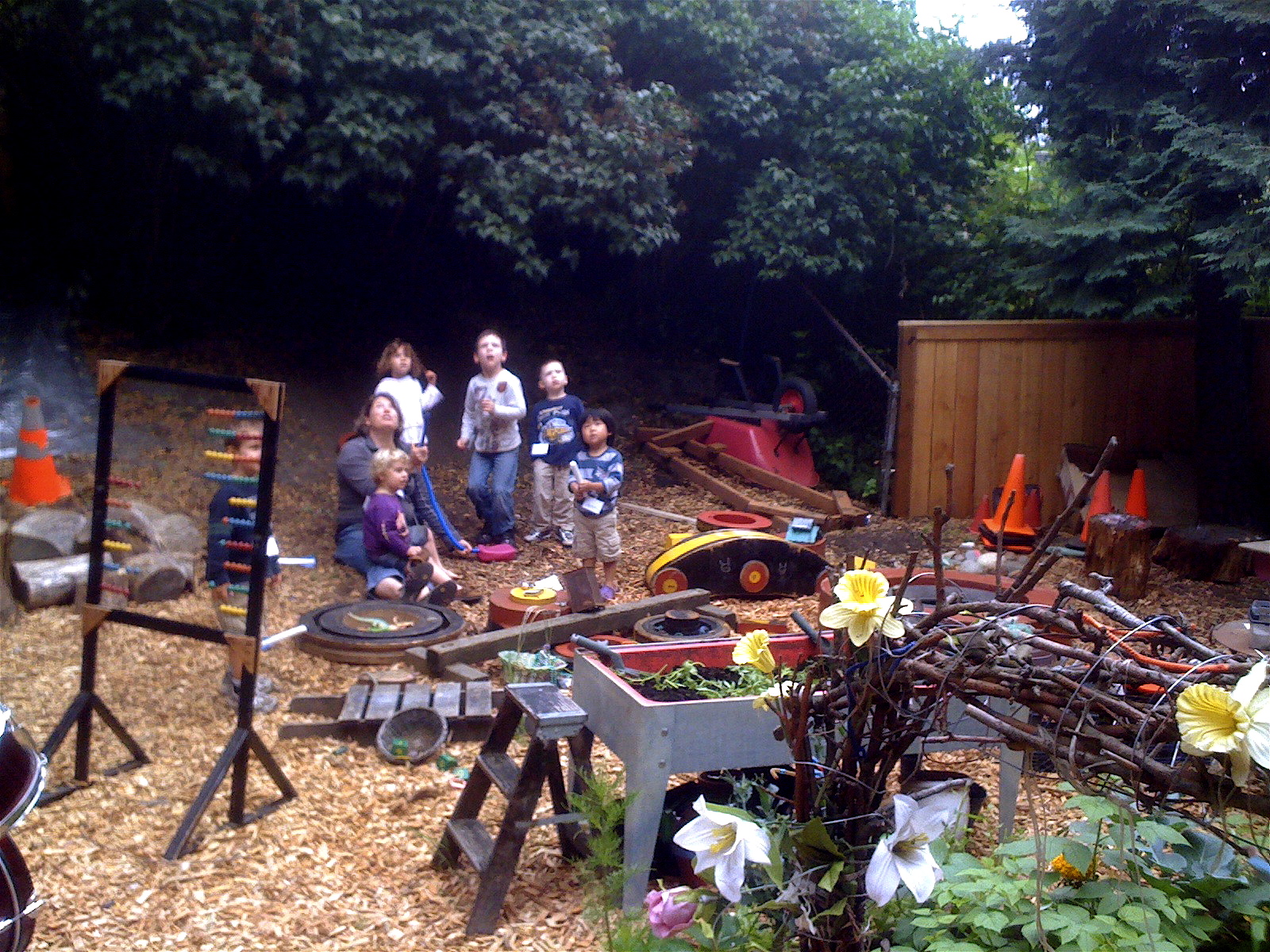
Give them long stretches of time and space to play. Fill your program with loose parts and quality open ended materials. Be there to facilitate and support them. Let the children lead you to what interests them.


When the children want to hear a story, read to them. When they want to sing a song, sing. When they want to color or paint, let them. Most importantly, just let them play.


Trust them. They are learning.

We know the benefits of play based learning for the children, but there are benefits for us as well. Letting go of the stress of trying to do it all will make you a calmer and happier provider.


Let go of the over structured activities and teacher controlled schedules. Most importantly take the time to just BE with them, because at the end of the day that’s what the children will remember most. 


Wednesday, March 4, 2015

Choose Your Own "Paintbrush"


Embracing play, and child led investigations means letting go of adult agendas. It means dropping your preconceived ideas of what "needs" to happen at the door, and it means trusting the children. You may have some ideas of what might happen, but what or how things happen are not your decision to make. The investigation belongs to the children.


It does not mean that you as an adult don't have a role. It means that your job is to follow and to help meet the needs of each child, you are there to assist when needed and to be an invisible support.  In the art area it means being ready to help change out paper, refilling paint containers, and assisting children to navigate social situations when needed. It also means cleaning and refreshing places so that it is ready for the next child.

This is HARD! I know- to let go of all of the "cute" projects and crafts that take you hours to prepare, and children seconds to complete. (or were primarily completed by adults because the child could not make it happen on their own). Early childhood art is about the process-- not the product. Yet, so many of the marketed "curriculum" out there offer product orientated experiences for children and don't even get me started on the amount of projects shared online via social media that really, are truly not developmentally appropriate and focus far too much on the product.


Art for young children needs to be about exploring and investigating materials. When children are truly engaged these experiences could take hours, or even days. The process is often repeated again, and again, and again. Children need an opportunity to continue to explore, to master and to choose to engage until they have exhausted their curiosities. This could mean more paper, and more paper, and more paint, and more paint.... and the same thing for a month (or even longer). This is where you need to remember to trust the child-- they know when they are ready to move on. They know if they still need to explore, and as Bev Bos says they need to use too much before they understand to use just enough.


At my house (remember, I run a home based program), we have a rather large art area and tinkering station. The children have almost unlimited access to the materials. (The art area is located in our kitchen and the table is the same table we eat at, so we do need to make sure that we are able to serve meals and limit art activities to outside of meal times). When children choose to create art, they choose their canvas- various types of paper, plexi-glass, and random other objects (wood chunks, cardboard boxes..... ) They choose if they want to paint at the easel, at the table, on the floor.....  the children choose what they would like to use- crayons, pencils, markers, paint..... and what color or type of each.  Children almost always choose paint-- and when they choose paint, they also have to choose their "paintbrush"


Our art area is stocked with a vast array of "paintbrushes"-- all kinds of odds and ends. It is amazing to see the explorations that happen when children can choose and use different types of things to paint with. It is also interesting to see what the children come up with- and what explorations or "paint brushes" they bring to the area.  

Some of our more recent favorites include:

Bath Puffs
Q-Tips
Power Drills (with a paint brush instead of drill bit)
Suction Cup Darts (shot with a crossbow)
Hand Drills
Fly Swatters
Mini Rollers
Plungers
Finger Nail Brushes
Squeeze Bottles
Turkey Basters
Potato Mashers
Blow Dryer

You can find some more idea by following my Pinterest Board WE LOVE PAINT!

What is your favorite paintbrush to supply to the children? Please stop by and share on the Play EmPowers Community Facebook page or leave me a comment below!


Monday, March 2, 2015

Don't Just Do Something, Sit There.....Part 1


As early childhood educators and teachers most of us love to get down and dirty and play. Love to be fully engaged with the kids, play as if we were kids. What can be wrong with that? Why am I selective about these times?

This is the first part of a two part series on facilitation. 

Facilitating kids learning often means stepping back and observing, watching and seeing when and where I am needed. I do jump in and play with the children but always for a specific reason that benefits a child or the community. This comes from watching and understanding when I am needed and when I am not. 

All kids want attention, to be included but not all want to be part of activity or group. Like it or not an adult has power and most kids crave an adults attention and approval. When I jump into play or become very involved with one of the kids the other kids will often stop what they are doing and come over and join the game/activity. Part of the draw is knowing they can gain my attention and my approval if they join with the group and/or activity. What's the problem with this? 

The children often stop what they are doing. 

As a facilitator it is my job to scaffold, to provide assurance when the child seeks it, to help them follow their own path. If children are often stopping what they are doing I am no longer facilitating child chosen, child directed learning.  Instead the children do what I want them to do because I leading with my example, with my focus and with my attention. 

Many teachers make teaching look effortless through this technique as their students seem to follow them with a Peter Pan like atmosphere. But child directed learning isn't about kids following teachers, it is about kids following their own path. 

I know some are thinking. Oh - I know many of my kids that would keep chugging along and ignore the group. So let's look at them. If I am involved somewhere else I am not giving attention to their activity and I miss opportunities to facilitate. By missing those opportunities and by putting my attention elsewhere I also put value on that activity with my attention and by default put less value on a solitary child's activity.

What message does this send to the child when their activity is not valued?  Equally important - what message does this send to the group when this child is not as valued? 

Facilitating by need means I see when a child needs scaffolding, when they need reassurance, when they need to explore, when they need to be in process without me and so so much more. When I meet that need I send the message to the child that their ideas, discoveries and processes are valued.  I also send a message to the group that everyone's ideas, discoveries, processes are valued. This helps children see not only themselves and their place in the community but also that everyone, though different, has value and contributes to the community in their own way.